Thursday, January 14, 2016

The Modernist Grid

The grid is a ubiquitous sign of modernity. It is a schematic that is a universe tool in organizing visual information although it is more associated with modern art and architecture, science and technology, and modern cities.

The grid can mirror the vertical and horizontal edges of a page, canvas or screen.  It emphasizes flatness, straightness, and the materiality of its support. It can function as an organizing structure as in the case of Chuck Closes painting Emma, or as form itself as in the case of Mondrian's and Martin's paintings.

 Emma, Woodcut print 2002  Chuck Close


Composition in Red, Blue, and Yellow, Piet Mondrian


On A Clear Day, 1973, Agnes Martin


As an organizing tool it guides the disposition of elements within the two-dimensional plane. It can function as an invisible or visible structure. It activates the entire space into a structured field. It is a rationale for why and how parts are placed within the space.

Tokyo Dolores Japanese Dance, Performance Art


Tokyo Dolores is a Japanese performance art project that brings together acrobatics, anime, fantasy and folklore, Japanese pop and subcultures, street fashion and elaborate costumes, and pole dancing. Tokyo Dolores collaborates with artist, costume designers, videographers, and other creative people during the production of their live performances. They explore the deep and complex spirituality of Japanese girls.


Experimental Japanese Animator Yoji Kuri


Yoji Kuri, born in Japan in 1928, is a cartoonist and independent filmmaker who gave birth to a modern-styled, independently made, adult-aimed animation in early 1960 Japan.  He is considered part of the first wave of experimental animators. His work involves dark comedy using farce and morbid humor. He works in a multitude of styles, but generally his animations are surreal, erotic, witty and strangely disturbing.


Love-Ai (1963)


Aos (1964)


The Room

http://www.pelleas.net/aniTOP/index.php/the_first_wave_of_independent_animators_
https://en.wikipedia.org/wiki/Yōji_Kuri

Basic Compositional Principles


Understanding compositional principles are important as a starting point to becoming a more informed viewer. Artists use, bend and break these principles  as necessary in conveying their message and creating visual excitement. For the viewer when you know the underlying principles behind how a composition is organized, your appreciation and understanding of the work is increased. Compositional structure is not purely an aesthetic issue; the visual order or structural logic of a work of art or design conveys  meaning, and an artist or designer tries to correlate that meaning with his or her content and intention whether consciously or intuitively.


Wednesday, August 10, 2011

Studio update


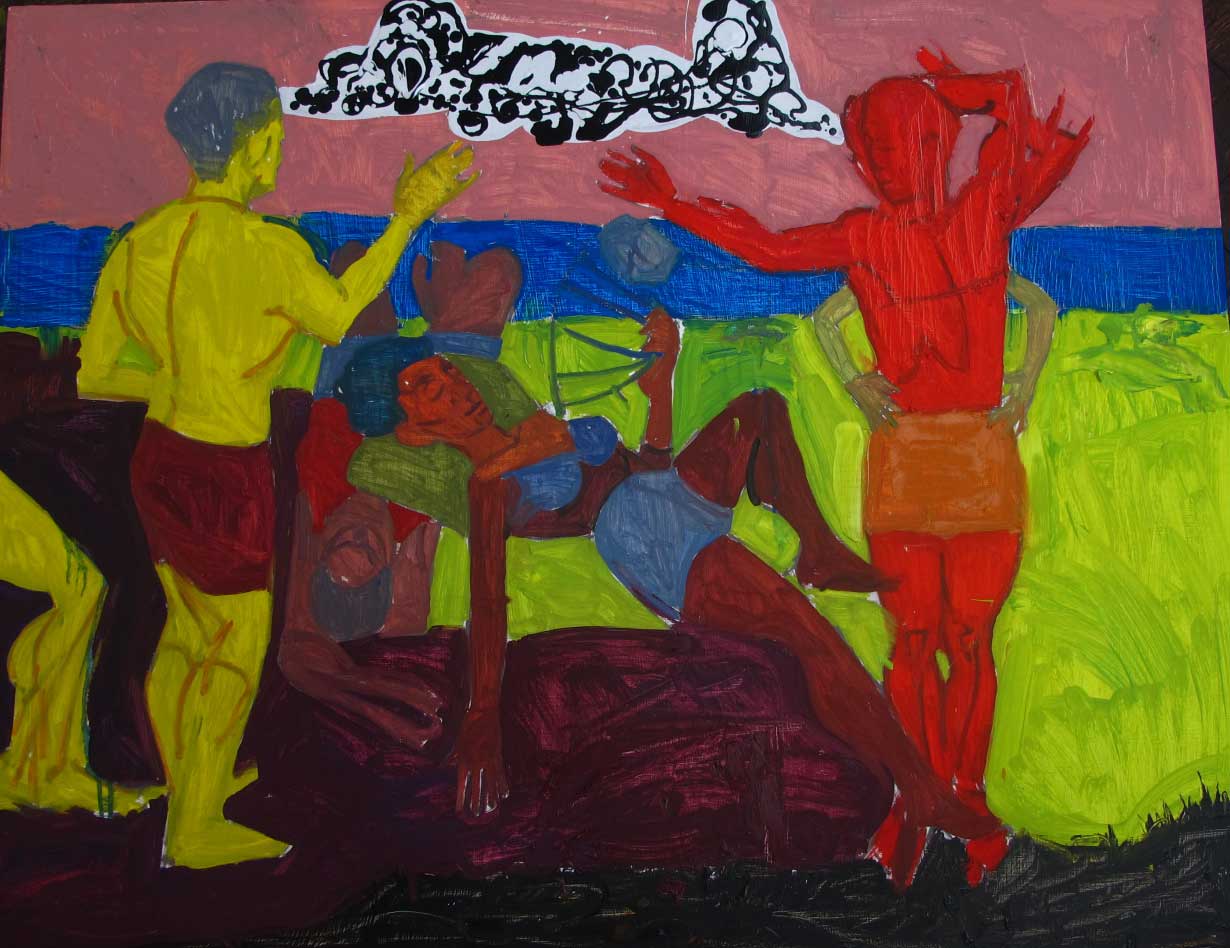
This painting like most of my paintings go through many revisions. My painting are discovered  during the making process, so that the end is always a surprise to me where I end up.  I getting the feeling this painting is getting close to resolution.

This is a new painting I have just begun. It is based on the drawing below. I am experimenting with a more aggressively painterly approach.  I am trying to emphasize the materiality of paint and its application, the presence of surface  and greater abstract tension between image and pictorial elements.

A small drawing in pencil.


Yes I have changed this one again, now it has turned into a night painting.

I thought the painting was finished, but then I decided to change it. So the journey continues. Change one thing, then every thing else has to adjust. The previous state is below.

I like how it was, but I had to change it nevertheless, sometime I guess you have to be willing to make a bad painting to discover something new and unforeseen.


This one is near completion.


This one is almost done, I am sure of it.

Sunday, May 1, 2011